 b400633dc2
Fixes #107059.

The SceneTreeDock was not tracking script changes in selected nodes in any capacity as far as I could assess. To do
that, my solution essentially connects the "script_changed" signal from selected nodes to
"SceneTreeDock::_update_script_button()" whenever the selection changes. It actually queues the update to make sure it
happens only once no matter how many nodes are selected.

However, only connecting that signal would leave previously selected nodes with a signal connection that should no
longer exist. To properly disconnect previously selected nodes, we have to store the list of currently selected nodes so
we can disconnect them when the selection changes.

The commit also includes some improvements to the SceneTreeDock class:

1. Remove unnecessary initialization in SceneTreeDock

This field is already initialized in the line that declares it. As such, initializing it on the constructor as well as
is redundant.

2. Queue script button updates in scene tree dock

Since we now have the option to defer the script button update and make sure it only runs once per frame, it's always
best to use the queued version of the update from a performance perspective. I'm not entirely sure if there could be any
unexpected side effects but it is a minor self-contained UI update, so it's likely a relatively safe change.

The replacement includes the bindings since it is a requirement for the other replacements in the class to work
(UndoRedo needs their method names registered in the class DB). It should be OK to remove the old non-queued bindings
too even though they are accessible in the public API because it is a "unofficial" method starting with an underscore.


Godot Engine

2D and 3D cross-platform game engine
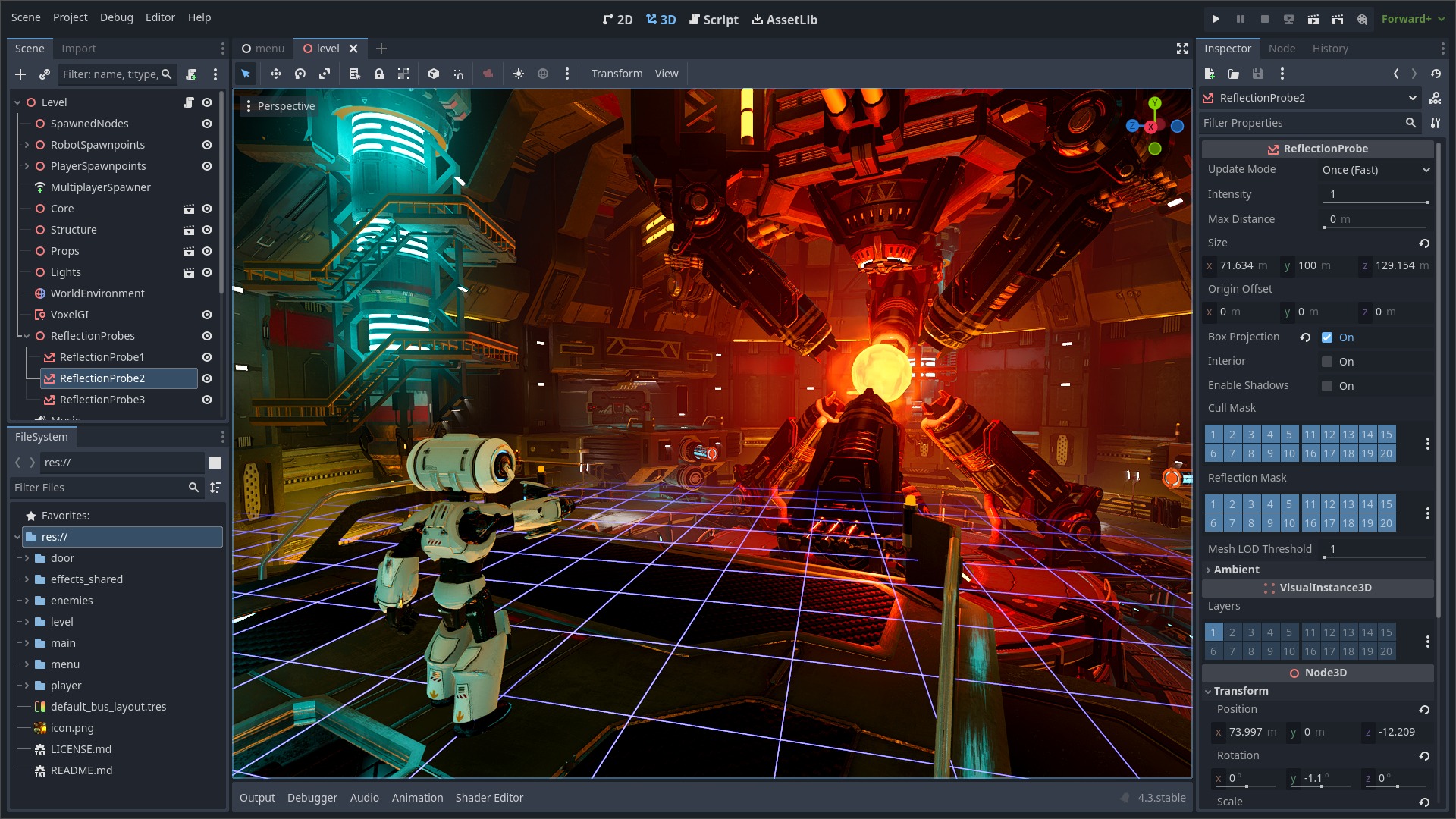
Godot Engine is a feature-packed, cross-platform game engine to create 2D and 3D games from a unified interface. It provides a comprehensive set of common tools, so that users can focus on making games without having to reinvent the wheel. Games can be exported with one click to a number of platforms, including the major desktop platforms (Linux, macOS, Windows), mobile platforms (Android, iOS), as well as Web-based platforms and consoles.
Free, open source and community-driven
Godot is completely free and open source under the very permissive MIT license. No strings attached, no royalties, nothing. The users' games are theirs, down to the last line of engine code. Godot's development is fully independent and community-driven, empowering users to help shape their engine to match their expectations. It is supported by the Godot Foundation not-for-profit.
Before being open sourced in February 2014, Godot had been developed by Juan Linietsky and Ariel Manzur (both still maintaining the project) for several years as an in-house engine, used to publish several work-for-hire titles.
Getting the engine
Binary downloads
Official binaries for the Godot editor and the export templates can be found on the Godot website.
Compiling from source
See the official docs for compilation instructions for every supported platform.
Community and contributing
Godot is not only an engine but an ever-growing community of users and engine developers. The main community channels are listed on the homepage.
The best way to get in touch with the core engine developers is to join the Godot Contributors Chat.
To get started contributing to the project, see the contributing guide. This document also includes guidelines for reporting bugs.
Documentation and demos
The official documentation is hosted on Read the Docs. It is maintained by the Godot community in its own GitHub repository.
The class reference is also accessible from the Godot editor.
We also maintain official demos in their own GitHub repository as well as a list of awesome Godot community resources.
There are also a number of other learning resources provided by the community, such as text and video tutorials, demos, etc. Consult the community channels for more information.

