 acf439e96d
Fixes #90017
Fixes #90030
Fixes #98044

This PR makes the following changes:

# Force processing of GPU commands for frame_count frames

The variable `frames_pending_resources_for_processing` is added to track
this.

The ticket #98044 suggested to use `_flush_and_stall_for_all_frames()`
while minimized.

Technically this works and is a viable solution.

However I noticed that this issue was happening because Logic/Physics
continue to work "business as usual" while minimized(\*). Only Graphics
was being deactivated (which caused commands to accumulate until window
is restored).

To continue this behavior of "business as usual", I decided that GPU
work should also "continue as usual" by buffering commands in a double
or triple buffer scheme until all commands are done processing (if they
ever stop coming). This is specially important if the app specifically
intends to keep processing while minimized.

Calling `_flush_and_stall_for_all_frames()` would fix the leak, but it
would make  Godot's behavior different while minimized vs while the
window is presenting.

\* `OS::add_frame_delay` _does_ consider being minimized, but it just
throttles CPU usage. Some platforms such as Android completely disable
processing because the higher level code stops being called when the app
goes into background. But this seems like an implementation-detail that
diverges from the rest of the platforms (e.g. Windows, Linux & macOS
continue to process while minimized).

# Rename p_swap_buffers for p_present

**This is potentially a breaking change** (if it actually breaks
anything, I ignore. But I strongly suspect it doesn't break anything).

"Swap Buffers" is a concept carried from OpenGL, where a frame is "done"
when `glSwapBuffers()` is called, which basically means "present to the
screen".

However it _also_ means that OpenGL internally swaps its internal
buffers in a double/triple buffer scheme (in Vulkan, we do that
ourselves and is tracked by `RenderingDevice::frame`).

Modern APIs like Vulkan differentiate between "submitting GPU work" and
"presenting".

Before this PR, calling `RendererCompositorRD::end_frame(false)` would
literally do nothing. This is often undesired and the cause of the leak.
After this PR, calling `RendererCompositorRD::end_frame(false)` will now
process commands, swap our internal buffers in a double/triple buffer
scheme **but avoid presenting to the screen**.

Hence the rename of the variable from `p_swap_buffers` to `p_present`
(which slightly alters its behavior).
If we want `RendererCompositorRD::end_frame(false)` to do nothing, then
we should not call it at all.

This PR reflects such change: When we're minimized **_and_**
`has_pending_resources_for_processing()` returns false, we don't call
`RendererCompositorRD::end_frame()` at all.

But if `has_pending_resources_for_processing()` returns true, we will
call it, but with `p_present = false` because we're minimized.

There's still the issue that Godot keeps processing work (logic,
scripts, physics) while minimized, which we shouldn't do by default. But
that's work for follow up PR.


Godot Engine

2D and 3D cross-platform game engine
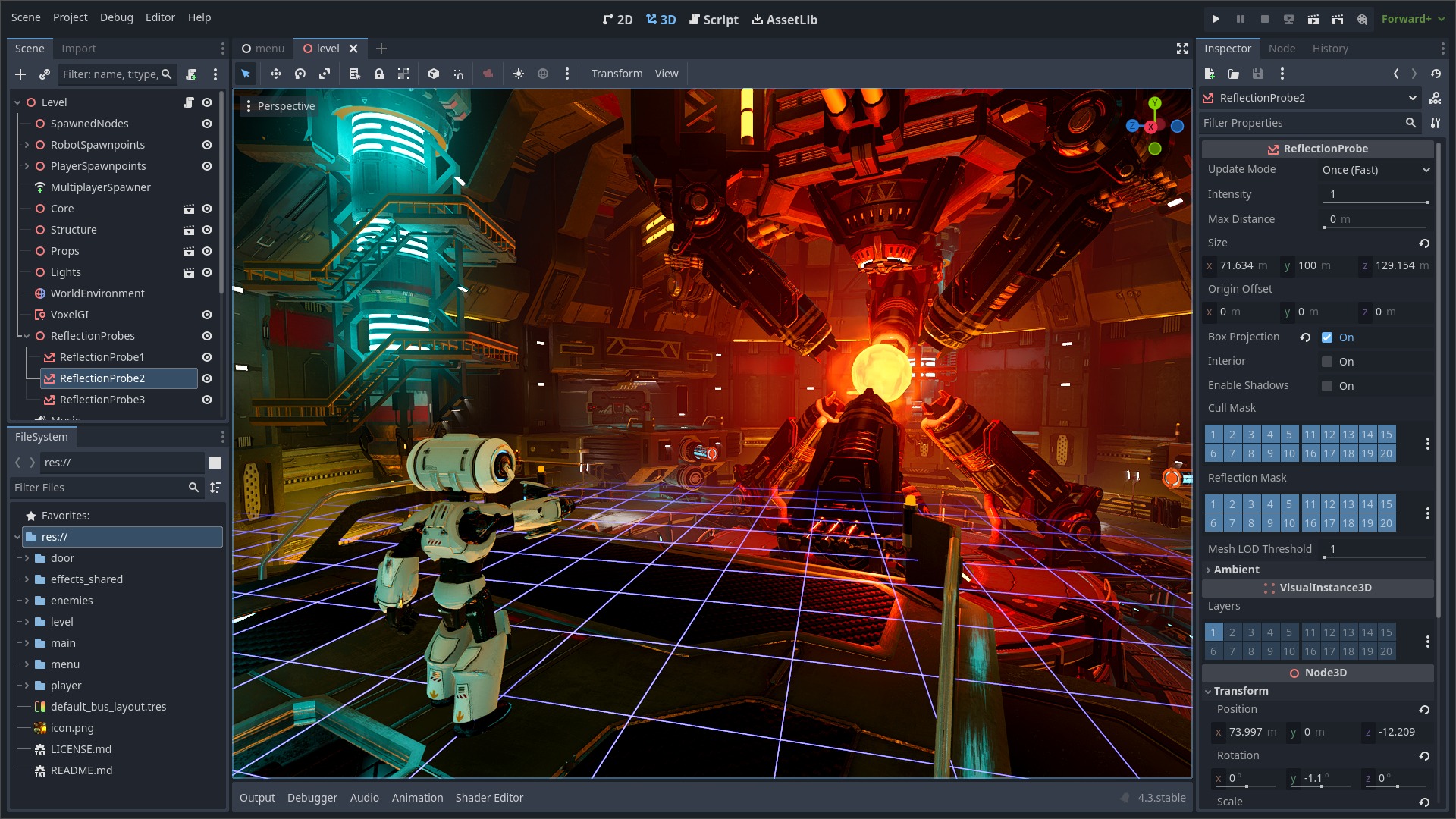
Godot Engine is a feature-packed, cross-platform game engine to create 2D and 3D games from a unified interface. It provides a comprehensive set of common tools, so that users can focus on making games without having to reinvent the wheel. Games can be exported with one click to a number of platforms, including the major desktop platforms (Linux, macOS, Windows), mobile platforms (Android, iOS), as well as Web-based platforms and consoles.
Free, open source and community-driven
Godot is completely free and open source under the very permissive MIT license. No strings attached, no royalties, nothing. The users' games are theirs, down to the last line of engine code. Godot's development is fully independent and community-driven, empowering users to help shape their engine to match their expectations. It is supported by the Godot Foundation not-for-profit.
Before being open sourced in February 2014, Godot had been developed by Juan Linietsky and Ariel Manzur (both still maintaining the project) for several years as an in-house engine, used to publish several work-for-hire titles.
Getting the engine
Binary downloads
Official binaries for the Godot editor and the export templates can be found on the Godot website.
Compiling from source
See the official docs for compilation instructions for every supported platform.
Community and contributing
Godot is not only an engine but an ever-growing community of users and engine developers. The main community channels are listed on the homepage.
The best way to get in touch with the core engine developers is to join the Godot Contributors Chat.
To get started contributing to the project, see the contributing guide. This document also includes guidelines for reporting bugs.
Documentation and demos
The official documentation is hosted on Read the Docs. It is maintained by the Godot community in its own GitHub repository.
The class reference is also accessible from the Godot editor.
We also maintain official demos in their own GitHub repository as well as a list of awesome Godot community resources.
There are also a number of other learning resources provided by the community, such as text and video tutorials, demos, etc. Consult the community channels for more information.

